


The complete guide to construction site signage — what’s required, what’s smart, and what wins you more work.
Here’s what most contractors get wrong: they think a few “Hard Hat Required” signs and a project board cover it. Then the inspector shows up.
We’ve been manufacturing construction signs for over 50 years. We’ve seen projects get shut down — not because of structural issues, but because the sign package wasn’t compliant. A $200 sign could have prevented a $15,000 fine. That math isn’t complicated.
The Signs Every Construction Site Needs (No Exceptions)
1. OSHA Safety Signs
This isn’t optional. OSHA 29 CFR 1926.200 requires specific signage on every construction site. Period.
Danger Signs — Immediate life-threatening hazards. Red, white, and black. Think: high voltage, confined spaces, excavation zones.
Warning Signs — Hazards that could cause serious injury. Orange background. Used for: falling objects, heavy equipment zones, chemical storage.
Caution Signs — Minor injury risks. Yellow background. Wet floors, uneven surfaces, overhead work.
Notice Signs — Policy and procedural info. Blue background. PPE requirements, site rules, emergency contacts.
2. Project Identification Signs
Every job site needs a sign that tells the public who’s building what. This isn’t just legal — it’s marketing.
- Project name
- Owner/developer name
- General contractor name and logo
- Architect name
- Expected completion date
- Permit number (where required)
Your project sign is seen by hundreds of people daily — potential clients, subcontractors, suppliers, inspectors. It’s a billboard you don’t pay monthly rent on.
3. Directional and Traffic Signs
Construction sites are chaos for anyone who doesn’t work there. Delivery trucks, inspectors, client visits — everyone needs to know where to go.
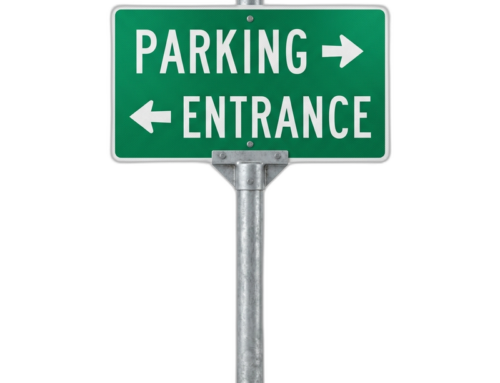
- Site entrance and exit
- Delivery/pickup areas
- Office/trailer location
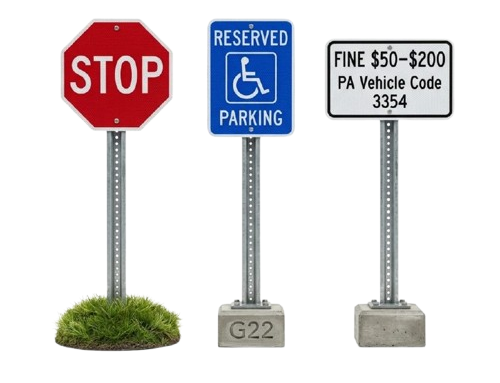
- Parking designations
- Speed limits
- One-way traffic flow
4. Safety and Hazard Signs
Beyond OSHA’s basic categories, specific hazards require specific signage for fall protection zones, excavation and trenching areas, electrical hazards, hazardous materials, fire safety, and confined spaces.
5. Regulatory and Compliance Signs
Depending on your jurisdiction, you may need building permit display, environmental protection notices, noise ordinance compliance, stormwater pollution prevention (SWPPP) signs, and historic district notifications.
What Most Contractors Miss
Accessible route signage. If there’s any chance the public will walk near your site — and there always is — you need ADA-compliant temporary wayfinding. One wheelchair user who can’t navigate your site equals a potential ADA lawsuit averaging $75,000 in settlements.
Emergency information signs. Where’s the nearest hospital? What’s the site address for 911? Who’s the safety contact? These should be posted at every entry point and the site office.
Multilingual signs. OSHA doesn’t explicitly require bilingual signage, but if your workforce includes Spanish-speaking workers, English-only safety signs don’t meet the employee understanding standard. Courts have ruled on this.
Signs That Win You More Business
Smart contractors use their sign package strategically. Project ID signs as marketing — we’ve had clients tell us they landed new projects specifically because someone saw their job site sign and called. Branded safety signs signal professionalism. Completion signs posted when you finish are the cheapest marketing you’ll ever do.
How to Build Your Sign Package
- Site assessment — we look at your site plan, jurisdiction requirements, workforce, and public proximity
- Compliance review — we identify every federal, state, and local sign requirement
- Design — custom-branded signs that meet compliance AND look professional
- Manufacturing — built to last, not flimsy corrugated plastic that falls apart in a month
- Installation — proper placement, proper height, proper mounting
- Maintenance — signs get damaged, regulations change, we stay on top of it
Ready to Get Started?
Graphics 22 Signs has been manufacturing construction signage for over 50 years. We work with general contractors, subcontractors, and developers across western Pennsylvania, Ohio, West Virginia, Maryland, New York, and DC.





Leave A Comment